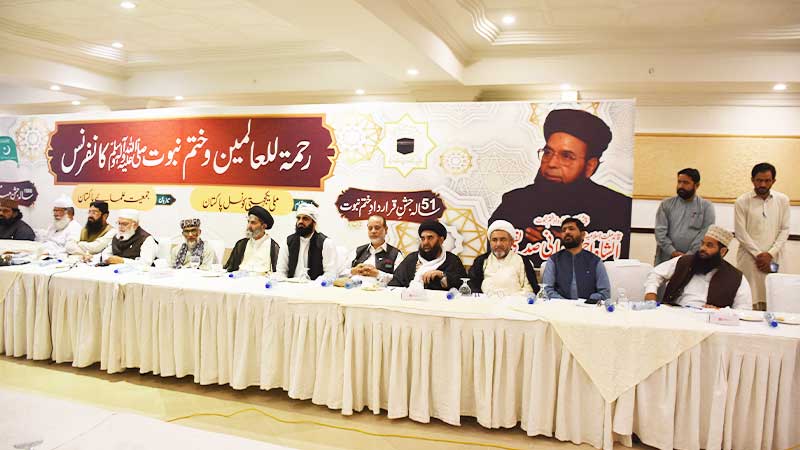

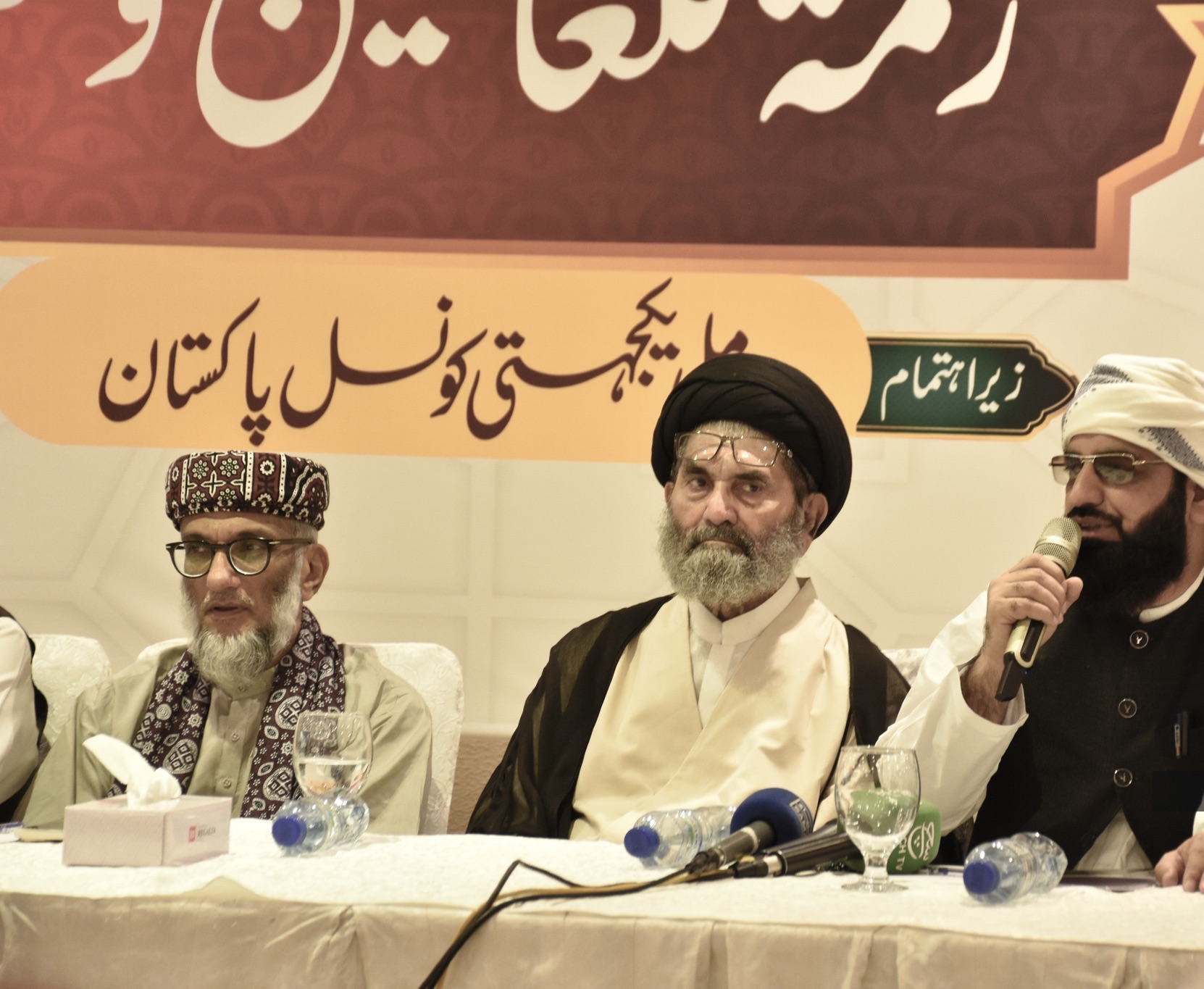
Islamabad — The National Rahmat-ul-Lil-Alameen Conference, organized by Milli Yakjehti Council Pakistan and hosted by Jamiat Ulema-e-Pakistan, was held at a private hotel in Islamabad. The conference was chaired by Dr. Sahibzada Abul Khair Muhammad Zubair, President of Milli Yakjehti Council Pakistan and Jamiat Ulema-e-Pakistan. Prominent ulema, senior spiritual leaders, and religious and political figures from various schools of thought attended in large numbers.
Among the participants were: Leader of the Jafaria Community Ayatollah Allama Syed Sajid Ali Naqvi; Liaqat Baloch Ali Muhammad Khan; Allama Syed Iftikhar Hussain Naqvi; Pir Mian Abdul Khaliq; Mufti Gulzar Ahmad Naeemi; Pir Abdul Haq Thani; Qari Muhammad Yaqub Sheikh; Syed Nasir Abbas Shirazi; Allama Arif Hussain Wahidi; Pir Syed Muhammad Safdar Shah Gilani; and other religious and political leaders.
In his presidential address, Dr. Sahibzada Abul Khair Muhammad Zubair said that the Holy Prophet Muhammad (peace be upon him) is mercy for all humanity, and that the survival and success of the Muslim ummah depend on implementing the Prophet’s exemplary conduct in individual and collective life. He stated that the Finality of Prophethood (Khatm-e-Nubuwwat) is the basis of faith and is non-negotiable. He asserted that the Law for the Protection of the Honor of the Prophet (Section 295) must not be rendered ineffective, and that no conspiracy against Islamic values or Pakistan will be permitted to succeed. He warned that any legislation in Parliament contrary to the Qur’an and Sunnah would amount to treason and rebellion against Article 73 of the Constitution; members of Parliament should legislate in accordance with their oath, otherwise those anti-religion and unfit members will be held accountable at all levels.
He said that bills in the National Assembly concerning prohibition of child marriages, the Minority Commission Bill, women’s rights legislation, and transgender acts are in conflict with Sharia. Expressing deep sorrow over rising terrorism and the martyrdom of security personnel across the country, he urged the government to revisit the National Action Plan and ensure the care of martyrs’ families. He emphasized that no initiative can succeed without national consensus and unity.
The conference expressed deep sorrow over the continuing rise in terrorism and the martyrdom of security personnel, especially in Mirpur Khas, Khyber Pakhtunkhwa and Balochistan, and urged the government to reconsider the National Action Plan agreed upon by national consensus, since no plan can succeed without such consensus.
In their joint declaration, participants said the atrocities against innocent Muslims in Palestine and the massacre of civilians in Gaza are a grave moment of concern for all humanity. It is regrettable that Muslim rulers, international bodies, and human rights organizations remain silent spectators. The declaration called on Muslim countries to take immediate and effective practical measures to assist the Palestinian people. All Muslim states should impose diplomatic and economic boycotts on Israel and boycott Israeli products. All international agreements — including those with Saudi Arabia — should be aligned with national aspirations, and details of the Pakistan–Saudi agreements should be made public so that Pakistanis are reassured and propaganda and opposing voices around the deal can be stopped. The nation must be taken into confidence.
A two-state solution is unacceptable on the Palestine issue. The Abraham Accords are against the foundations of Islam. Muslim rulers must make decisions in accordance with the Qur’an and Sunnah.
Practically, flood victims remain helpless. The government must take immediate and concrete steps to provide basic facilities in affected areas, resettle homeless families, and formulate a clear strategy to repair damage to agriculture and the economy.
At the close of the conference, all participants reiterated their resolve to continue peaceful struggle at all levels for protection of the honor of the Prophet, defense of Khatm-e-Nubuwwat, support for the oppressed people of Palestine and Kashmir, and implementation of the Prophetic system. They pledged to continue their efforts to resolve national problems such as terrorism, poverty, inflation, unemployment, and injustice in Pakistan.