

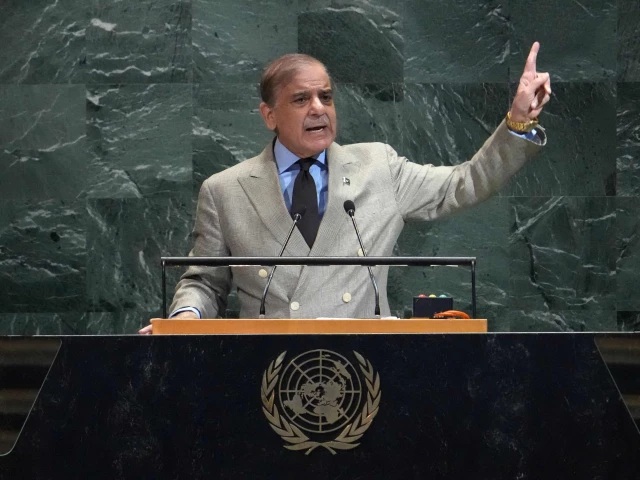
Prime Minister Shehbaz Sharif hailed the decisive response of Pakistan’s armed forces to Indian aggression as one that “will echo through the annals of history.” However, he called for peace, saying, “We have won the war, and now we seek to win peace.”
Addressing the 80th session of the United Nations General Assembly (UNGA) on Friday, PM Shehbaz said, “Pakistan’s foreign policy, guided by the vision of Quaid-e-Azam Muhammad Ali Jinnah, is rooted in peace, mutual respect, and cooperation. We believe in the peaceful settlement of disputes, dialogue, and diplomacy.”
He recalled that, from the same podium last year, he had warned that Pakistan would act decisively against external aggression. “Those words of mine proved true. When in May this year, my country confronted unprovoked aggression from our eastern front, the enemy came shrouded in arrogance; we sent them back in humiliation, delivering a bloody nose,” he said.
The prime minister declared that Pakistan had shot down seven Indian aircraft as an act of self-defence under the UN Charter in response of India aggression.
He paid tribute to Pakistan’s armed forces, martyrs, and citizens for standing united during the confrontation, calling them an “unbreakable wall” against aggression.
“Pakistan’s foreign policy, guided by the vision of Quaid-e-Azam Muhammad Ali Jinnah, is based on peace, mutual respect and cooperation. We believe in the peaceful settlement of disputes, dialogue and diplomacy,” the prime minister told world leaders.
The prime minister accused India of seeking to gain political mileage from the Pahalgam tragedy by rejecting Pakistan’s offer of an independent international investigation. Instead, he said, India attacked Pakistani cities and targeted innocent citizens.
“In accordance with the right of self-defence under Article 51 of the United Nations Charter, our valiant armed forces mounted an operation of stunning professionalism, bravery and acumen,” he added.
He praised Chief of Army Staff Field Marshal Asim Munir’s leadership and highlighted the role of the Pakistan Air Force. “Repulsing the enemy attack under Air Chief Marshal Zaheer Babar Sidhu, our falcons took flight and etched their answer across the skies, resulting in seven of the Indian jets turned to scrap and dust.”
The prime minister also extended an offer to India for a comprehensive and result-oriented dialogue on all outstanding issues, emphasising that South Asia needs proactive, not provocative, leadership. “Pakistan stands ready for a composite, comprehensive and result-oriented dialogue with India on all outstanding issues. South Asia requires proactive rather than provocative leadership,” he said.
Reiterating Pakistan’s resolve to defend the rights of its ‘240 million people’ to the Indus waters, the prime minister warned that any violation of the treaty would be viewed as ‘an act of war.’
PM lauds Trump, Guterres
PM Shehbaz acknowledged the role of US President Donald Trump in facilitating a ceasefire between the two nuclear-armed states.
“Though in a position of strength, Pakistan agreed to a ceasefire facilitated by President Donald Trump’s bold and visionary leadership. His timely and decisive intervention helped avert a full-fledged war in South Asia, the consequences of which could have been catastrophic,” the prime minister said.
In recognition of what he described as Trump’s “outstanding contribution to promoting peace in our part of the world,” the prime minister revealed that Pakistan had nominated the US president for the Nobel Peace Prize.
Lauding UN Secretary-General António Guterres for guiding the organization through difficult times, he urged the global community to recommit to justice, sovereignty, and respect for international agreements.
The premier also expressed gratitude for the diplomatic support extended by Pakistan’s allies. “We are profoundly thankful to our friends and partners, including China, Turkey, Saudi Arabia, Qatar, Azerbaijan, Iran, the UAE, and the UN Secretary General, for their steadfast support during this pivotal time,” he stated.
Solidarity with people of Kashmir and Palestine
PM Shehbaz also delivered a forceful pledge of solidarity with the people of Kashmir, assuring them that “I stand with you, the people of Pakistan stand with you,” and asserting that “one day soon, India’s occupation of Kashmir will come to a grinding halt.”
He reiterated Pakistan’s call for Kashmir’s “fundamental right to self-determination” to be fulfilled through “an impartial plebiscite under the auspices of this very Organization, the United Nations,” and urged New Delhi to enter a comprehensive, result-oriented dialogue on outstanding issues.
Turning to the Middle East, the prime minister described the plight of the Palestinian people as “one of the most heart-wrenching tragedies of our times,” calling the prolonged injustice “a stain on the global conscience.”
He condemned what he called “brutal occupation” in the West Bank, and said the sustained violence in Gaza had unleashed “unspeakable terror upon women and children.” He accused Israeli authorities and illegal settlers of acts of brutality that have gone unchallenged, and said the current campaign in Gaza would be remembered “as one of history’s darkest chapters.”
The prime minister urged the international community to act immediately to secure a ceasefire, saying, “We must not fail the children of Gaza or any child anywhere in the world — we must find a path to a ceasefire now.”
He announced Pakistan’s firm support for the establishment of a sovereign Palestinian state based on pre-1967 borders with Al-Quds (Jerusalem) as its capital, and called for a full and committed effort to end Israel’s control over Palestinian territory.
He also condemns Israel’s recent attack on Doha, calling it a serious violation of sovereignty and territorial integrity. “Pakistan stands unwaveringly with our brothers and sisters in Qatar,” the premier said.
The premier further cautioned that the world has entered a more complicated phase, where international laws are being openly violated.

