

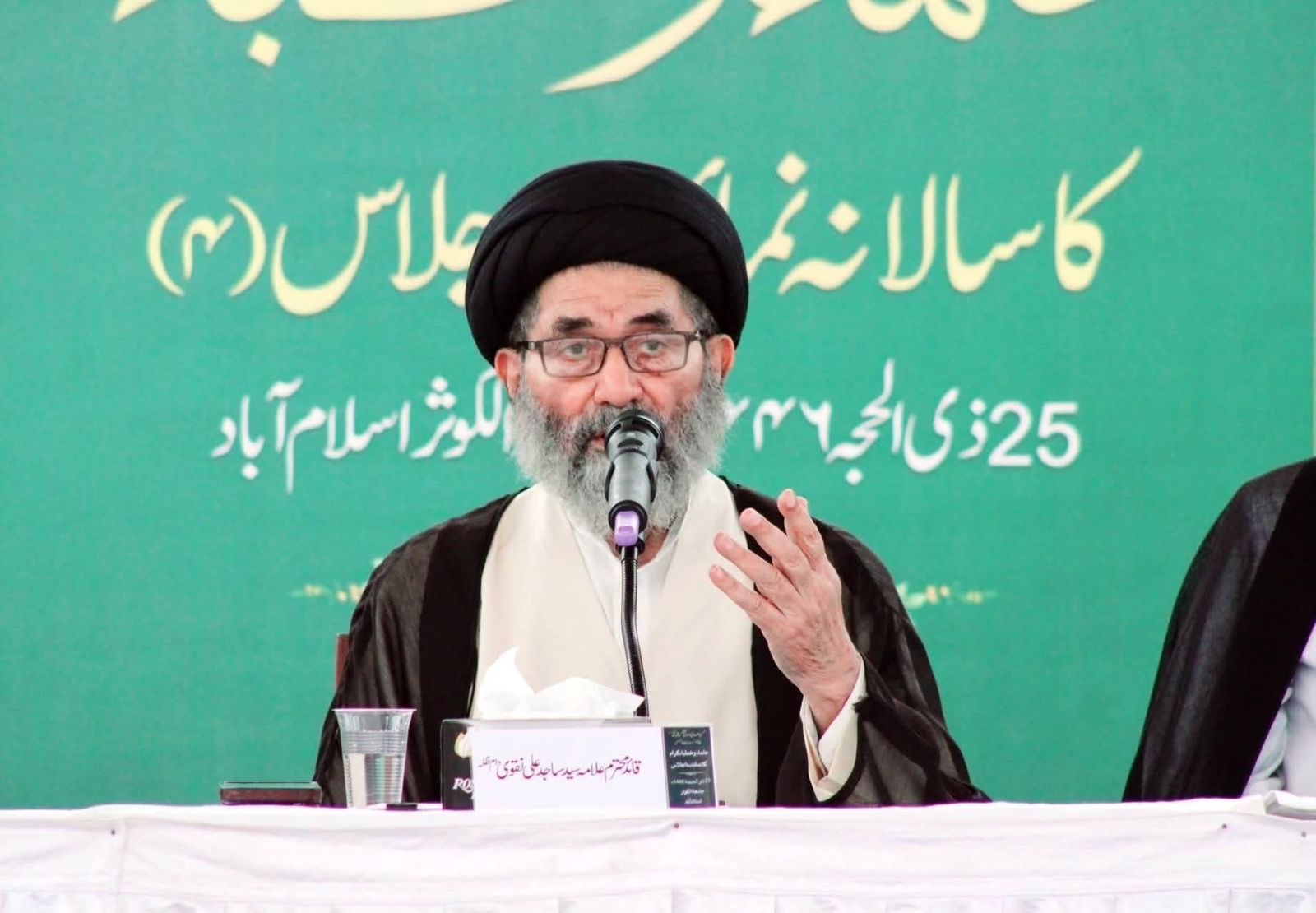
Rawalpindi / Islamabad – October 26, 2026
On the blessed birth anniversary of the fourth Imam, Ali ibn al-Husayn Zain al-Abidin (peace be upon him), observed on the 15th of Jumada al-Awwal, Ayatollah Syed Sajid Ali Naqvi, Leader of the Shia Muslims in Pakistan, stated that the Imam endured extraordinarily difficult and severe circumstances from his birth, through the tragedy of Karbala, until his final moments. Through his life, he laid enduring foundations of patience and steadfastness for humanity, inspiring people in every era to draw strength and courage from remaining committed to the truth.
He explained that Imam Zain al-Abidin (AS) possessed such noble character that people were naturally drawn to him. His personality became synonymous with humility, piety, asceticism, devotion, and worship of Allah, earning him the title “Zain al-Abidin,” meaning the adornment of the worshippers.
Ayatollah Syed Sajid Ali Naqvi further noted that Imam Sajjad (AS) was an eyewitness to the tragedy of Karbala. Through his accounts of its realities and his distinctive style of supplication and intimate prayers, he helped the world understand the true nature of the tragedy, countering the effects of false propaganda spread by ignorant and prejudiced elements. Through his conduct and actions, he exposed the Yazid-led approach and clarified the defining principles of the Hussaini path. His example, he said, remains a guiding model for all forces striving against falsehood.
He observed that Imam Zain al-Abidin (AS) established a spiritual path grounded in piety, asceticism, and devotion. He also bequeathed to the Muslim community a profound collection of supplications that illuminate hearts and minds, awaken inner awareness, help overcome the lower self, and strengthen one’s connection with Allah. Drawing upon this spiritual legacy in the modern age, when materialism increasingly dominates human life, can help pave the way toward salvation in this world and the Hereafter.
Referring to one of the Imam’s supplications, he quoted: “There are no two drops more beloved to Allah than a drop of blood shed by a martyr in His path and a tear shed in the darkness of night out of fear of Him and in the hope of drawing closer to Him.”
He emphasized that one of the fourth Imam’s distinctive contributions was teaching people, through supplications and intimate prayers, how to turn directly to their Creator and address Him. Through worship, he also demonstrated how to discipline and control the self. His supplications encompass far more than spiritual devotion: they address the foundations of faith, the concept of divine unity, the status of prophethood and Imamate, solutions to human difficulties, the identification of individual and collective challenges, the need to strive to resolve them, and ways to acknowledge and correct one’s shortcomings and mistakes.
He added that transforming our lives through the supplications preserved in Al-Sahifa al-Sajjadiyya can help us gain control over ourselves, understand how to win people’s hearts, and contribute meaningfully to relieving the world’s problems and hardships through patience and wisdom.
The Leader of the Shia Muslims in Pakistan stressed that humanity is currently surrounded by forces hostile to religion and human dignity. Contemporary forces following a Yazid-like path are seeking to undermine the Islamic world’s religious, intellectual, cultural, and civilizational traditions, destroy its resources, and erode its freedom and independence. He emphasized that, in these difficult circumstances, it is essential to draw upon the principles and enduring teachings of Imam Sajjad (AS), expose the renewed forms of Yazidism, highlight the hardships and deprivation faced by the Muslim Ummah, and foster greater awareness and understanding among people.

