

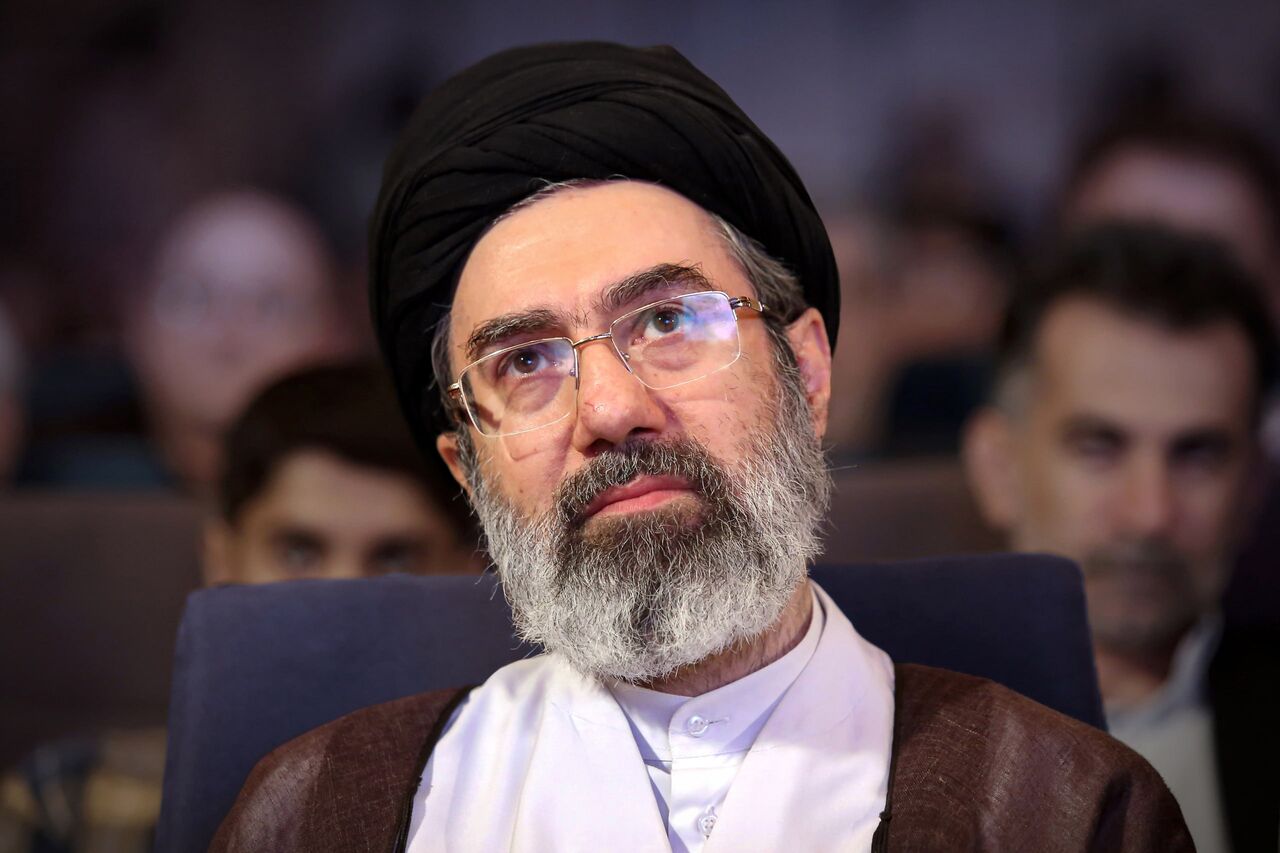
Ayatollah Seyyed Mojtaba Hosseini Khamenei, Leader of the Islamic Revolution, in a message addressed to distinguished talents and recipients of scientific and sports medals at international events, emphasized the unique role of gifted individuals, children, and young people who achieve success in science and sports in fostering hope, strengthening progress, and revitalizing the country. He described pushing beyond the existing boundaries of scientific knowledge as a key to enhancing Iran’s strength. He stressed that the country’s advancement, guided by the overarching strategy “Knowledge Is Power,” requires a profound and accelerated scientific renaissance. He also emphasized that officials must make the fullest possible use of the individual capabilities and collective wisdom of talented people while providing the infrastructure and conditions necessary for this scientific leap.
The text of the Leader of the Islamic Revolution’s message, read out on Monday evening by Hojjat al-Islam Haj Ali Akbari during a ceremony honoring recipients of scientific and sports medals, is as follows:
In the Name of Allah, the Most Compassionate, the Most Merciful
According to one account, these days mark the anniversary of the martyrdom of Fatima al-Zahra (peace and blessings be upon her), the purest and most truthful Lady among the women of Paradise. It is remarkable that the date of her martyrdom remains unknown, just as the burial place of this noble divine light has remained concealed, and that the true extent of her greatness and exalted status remains beyond human comprehension.
She is an exemplary figure in worship, devotion, and submission to Allah; an unparalleled model of intimate and comprehensive companionship with the Noble Messenger; and a symbol of wholehearted defense of the guardianship of the Commander of the Faithful, Imam Ali (peace and blessings be upon them and their family). She exemplifies the pursuit of knowledge and education, understanding the demands of the moment, rising to support the truth, steadfastness, and the clear articulation of truth.
She is also a foremost example of patience, sacrifice, selflessness, service without expectation of gratitude, and solidarity within society. She serves as a model of marriage and motherhood, and of raising children and the descendants of the pure Imams (peace be upon them), the leaders of humanity. She is also an example of striving, hard work, struggle, purity, moral excellence, piety, enlightenment, and spirituality. In a word, she is a role model for all believing women and men.
Among the radiant virtues of the Fatimid tradition is that it provides the revolutionary and Muslim Iranian people with a roadmap for major social movements, participation in public arenas and fields of struggle and jihad, and popular mobilization. It also offers guidance for pursuing scientific advancement and providing humble service without seeking recognition or gratitude.
At this stage in our history, our beloved Iran is more than ever a manifestation of determination and hope. The country’s talented and capable individuals and young people have an irreplaceable role in strengthening this hope, achieving progress, and advancing toward a bright future.
However, excellence is not confined to science, technology, sports, or particular skills. Any positive and valuable distinction can be an expression of excellence.
Today, we are witnessing this spirit of excellence among a group of people in our country who, with a broader vision, are striving to raise high the sacred flag of their homeland. These are the distinguished figures of insight and struggle. We consider individuals such as Reza Ali Khajavi and Ali Landi among those whose names deserve to be displayed prominently at cultural centers.
Among the finest members of society in this regard are the martyrs and those who have made sacrifices, who profoundly influenced the destiny of the Islamic Republic of Iran and its beloved people by giving their lives and health. They earned the distinction of servitude to the One and Only Lord.
First, I take this opportunity to congratulate all our beloved people, as well as everyone who contributed to these achievements, on the numerous honors, medals, and scientific accomplishments earned in the Olympiads in astronomy and astrophysics, mathematics, earth sciences, geography, physics, chemistry, biology, computer science and artificial intelligence, and the humanities, as well as the various recent sporting achievements.
I also express my appreciation for the determination and resolve of those leading the caravan of pride and hope and carrying the banner of the country’s progress. They represent all generations and fields of excellence, from children and young people to coaches, professors, and thinkers.
The motivation and hope that inspire talented individuals to transform the country are a burning flame that I have followed closely, both directly and from afar, for years and decades. Witnessing this great movement, which inspires hope among talented people and advances the country’s scientific journey, fills the entire Iranian nation with pride. Its achievements are evident in repeated victories, year after year, across scientific disciplines, Olympiads, and sports.
The outstanding rankings achieved by our dedicated athletes in various sports over recent days and months, along with the new records they have set, reflect their determination, ambition, perseverance, and faith.
Through their physical strength, spiritual, moral, and religious resilience, and sustained efforts, these athletes strengthen Iran’s standing in the eyes of nations around the world and demonstrate the vitality of the proud Iranian people.
The same is true of female athletes who shine internationally, with the hijab worn by Iranian women serving as a source of distinction. Sports medalists bring joy and enthusiasm to the hearts of the Iranian people and add to the dignity of the proud flag of the Islamic Republic of Iran. Each of these individuals contributes, in their own way, to giving meaning to the concept of a “Strong Iran” and plays an influential role in bringing it to life.
Since these days are witnessing growing activity and interest in science and research at universities, seminaries, and schools, I consider it appropriate to address a few brief remarks on this subject to those who love knowledge, the country’s talented individuals, and the thinkers of our beloved Iran.
Excellence is a divine blessing and gift, founded on talent and intellectual ability. The Iranian people, particularly the young people of our country, have been granted this great divine gift and resource.
Reason and devotion to Allah require people to give thanks for divine blessings. When gratitude is expressed at every level—in the heart, through words, and through actions—it opens the way for the blessing to reach its full potential.
Likewise, appreciation of the gift of excellence should begin with the talented individual and then extend to those around them: their parents, family, teachers, and professors, and ultimately their school, university, and the country’s wider institutions. These parties all contribute to developing, strengthening, and properly utilizing this ability.
Accordingly, talented individuals bear a major responsibility to express practical gratitude for this blessing. Alongside developing their abilities and expertise, they should employ their talents as effectively as possible to address the challenges facing their country and society.
A talented individual is not someone who merely possesses exceptional ability and intellectual potential, then considers themselves separate from others and thinks only of fleeting personal desires. Rather, a truly talented person is committed to developing their abilities, sees themselves as an active member of society, and uses their gifts and energy to advance both themselves and their community.
Iranian experts and researchers have demonstrated that knowledge and talent can be transformed into practical tools for addressing the problems of the people and the country. They have pursued the practical application of science, knowledge, and individual expertise across fields ranging from stem cells, nanotechnology, and biotechnology to advanced technologies in aviation, space, industry, mining, medicine, agriculture, nuclear science, energy, and infrastructure.
We all witness the effects and manifestations of this growing movement in our daily lives. Examples include generating electricity at power plants using Iranian-made turbines; applying advanced technological knowledge at desalination plants on the southern islands; flying agricultural drones over farms, orchards, and rice fields in the north to improve farming practices and the management of water and soil; enabling couples struggling with infertility to have children through Royan’s advanced technologies; diagnosing and treating difficult diseases with radiopharmaceuticals; monitoring land, water, and crops using remote-sensing satellites; and improving productivity and food security through scientific and technological innovation.
These are only a few examples from this vast and fruitful body of achievements. Many other accomplishments, particularly in defense and military fields, have repeatedly astonished the world and will continue to do so in the future.
A strong Iran rests on the foundation of scientific and technological capability. This is one of the most important factors underpinning Iran’s presence and influence in global affairs and the emerging world order.
Therefore, the key to strengthening this power lies in pushing beyond the existing boundaries of knowledge and innovating new solutions to the country’s scientific challenges.
The hostility and crimes committed by Iran’s enemies against its scientists and talented individuals reveal just how significant these people are in strengthening the country. The enemy that assassinated our prominent scientists and influential figures during the second and third imposed wars—and, years earlier, within their scientific communities and ordinary lives—cannot tolerate witnessing Iran’s progress and growing strength.
It employs every available means to weaken the talented people of our beloved Iran, from spreading despair and hopelessness to seeking control over their minds and spirits, absorbing them into the machinery of modern colonialism, and turning them into mere cogs in the machinery of Western plunder and capitalism.
Yet these adversaries fail to understand that every drop of blood shed by the martyred talents, scientists, professors, university students, and schoolchildren of this nation has sparked—and continues to spark—a powerful wave of determination and progress.
The Iranian people remember their ancient civilizational heritage, their many achievements in science and the arts, and the renowned scholars and intellectual figures their country has produced. At the same time, they remember the two centuries of severe backwardness and historical decline experienced during the Qajar and Pahlavi eras.
The Iranian people understand the value of the successful strategy expressed in the maxim, “Knowledge Is Power.” They recognize the results it has produced, foremost among them the refusal to submit to Western scientific domination and the rapid growth of scientific research and achievement by talented Iranians over the past three decades.
A significant part of this growth is attributable to the special measures and guidance adopted by our martyred leader, whose noble soul may Allah sanctify.
If, before the present period and the third imposed war, the new scientific renaissance was merely an essential and urgent recommendation for talented individuals, the experience of the two most recent wars has demonstrated to everyone that this scientific renaissance must now be deeper and faster.
To achieve this goal, officials in scientific, research, and technological institutions, along with all talented individuals and thinkers in our beloved Iran, must fulfill their fundamental responsibility in building a bright future for the Islamic Republic of Iran and advancing its progress and prosperity. They must give particular attention to the following points:
First: A serious, practical, and precise plan must be developed to advance basic sciences and the humanities in the country. Developing basic sciences such as physics, chemistry, biological sciences, and mathematics—which form the foundations of other applied sciences and technologies—is a driving force behind scientific and technological progress.
Every nation that has attained a distinguished position has done so through the basic sciences. Any country that fails to develop these disciplines will remain behind in the race for progress.
Second: Sustained attention must be devoted to discovering previously unknown facts, pushing beyond the current boundaries of basic sciences, and continuously competing to solve known problems that remain unresolved, particularly in mathematics. These pursuits should be treated as objectives and goals in their own right.
Third: Creativity and innovation are fundamental pillars of the scientific renaissance. Providing opportunities for creativity and positive imagination, which are essential to growth and the expansion of all or most scientific disciplines, is extremely important.
Scientific courage to create, innovate, and invent is equally necessary. Strengthening confidence at both the individual and national levels to undertake new experiments and explore previously untraveled paths is essential and highly beneficial. Providing appropriate and attractive incentives for those who produce influential innovations can help establish the conditions required to achieve this objective.
Fourth: Self-reliance in solving scientific problems, providing the necessary infrastructure, and removing technological obstacles are essential to enabling an effective role and operating across international boundaries. These measures can combine a strong domestic foundation with a forward-looking global perspective.
Fifth: Talented individuals must be given opportunities to apply their abilities in applied and experimental disciplines. This includes connecting industry with universities from the earliest years of university education and facilitating knowledge-based businesses. Such measures play an important role in applying knowledge and advancing talented individuals.
Coordinating the country’s scientific and technological capabilities and strengthening links between talented individuals, scientific and research centers, knowledge-based companies, industries, and even startups can help advance this goal.
Executive institutions must also support the entire knowledge chain, from research to consumption, with a focus on the major challenges facing the country today and in the future—from water, soil, food, and energy to artificial intelligence.
This approach can bring the work of professors and students out of university and research-center laboratories and into workshops and factories.
Such a major acceleration can occur only when economic interests and opportunities to commercialize products and services are aligned with the motivation and determination of talented individuals. A sustainable and continuous relationship must be established between scientific and research institutions on the one hand, and industry and consumer markets on the other.
Furthermore, talented individuals across theoretical and experimental disciplines at universities and seminaries should play a direct and active role in planning and policymaking. Their participation can contribute significantly to national progress.
Officials have a responsibility to make extensive use of the individual capabilities of committed talented people, as well as their collective intelligence and shared wisdom.
If we follow this path correctly, the centers of scientific gravity and knowledge hubs—particularly in certain branches of the basic sciences—will gradually shift from Western countries to Iran.
Within a number of years, the country will then become a scientific and technological reference point, and the goal articulated by our wise martyred leader, may his noble status be exalted, will be realized: that the Persian language becomes one of the world’s principal languages of science.
We pray to Allah, by the blessing of the blood of those martyred in the pursuit of excellence and through the blessed supplication of our master and leader, may Allah hasten his reappearance, to make possible a profound and accelerated scientific renaissance among the talented people and thinkers of our nation.
May Iran’s comprehensive progress continue toward greater strength, culminating in the establishment of a new Islamic-Iranian civilization.
Seyyed Mojtaba Hosseini Khamenei
October 26, 2026

