

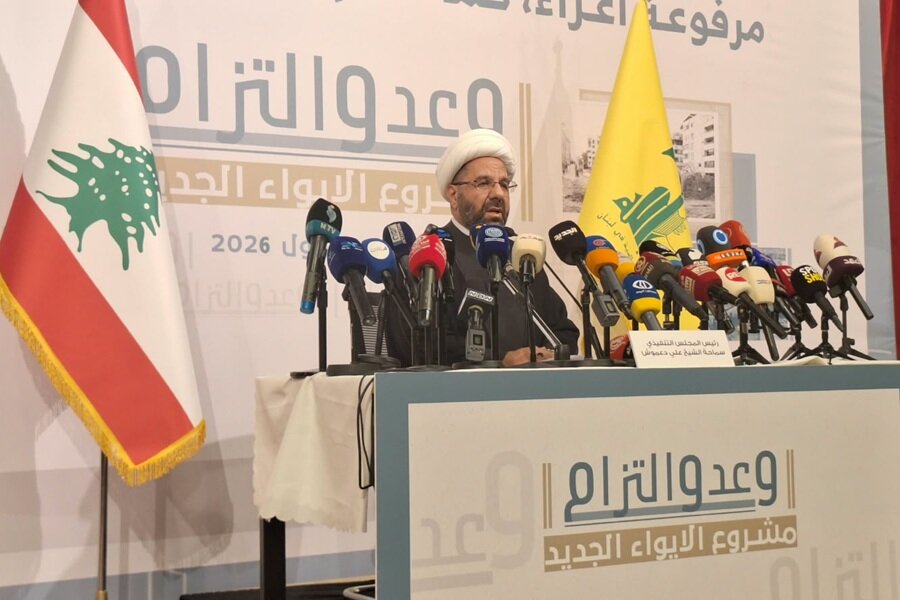
Sheikh Ali Daamoush, Head of Hezbollah’s Executive Council, stressed during a Hezbollah press conference held at the Ghobeiry Municipality Center in the southern suburbs to announce a housing project for displaced people that the option of resistance is a national necessity that cannot be abandoned in the presence of occupation, aggression, and Zionist ambitions toward Lebanon’s land.
He said that through its performance and sacrifices, the resistance had presented heroic epics, prevented the enemy from occupying the south, and offered the country a powerful example of defending its existence.
Daamoush stated that even if the enemy had managed to occupy, destroy, and demolish some villages and reach certain locations, this did not mean that it had become capable of establishing itself on Lebanese territory. He said the role of the resistance differs from that of conventional armies, as its function is to exhaust the occupation until it is expelled from the country. He added that developments on the ground resulting from particular balances of power did not in any way mean accepting surrender or submission, noting that such balances could change and that Lebanon had previously experienced similar circumstances that changed through the will of its people.
He added that after November 27, 2024, the authorities had either failed or been unable, intentionally or unintentionally, to provide means of protecting national sovereignty. Therefore, he said, they could not prevent their people from exercising what he described as a human, moral, and legal right. He called on the authorities to stop what he described as a process of “free concessions” and violations of the Constitution and National Pact, and to return to their people rather than relying on external options that, he said, aimed to undermine Lebanon’s foundations and deprive it of its freedom, sovereignty, and stability.
Daamoush called on the Lebanese people to recognize the seriousness of the current stage, place the interests of Lebanon above factional and partisan interests, and adopt dialogue and understanding instead of rhetoric of incitement and hatred, which he said deepens divisions among the components of Lebanese society. He stressed that Lebanon would remain a country for all its citizens regardless of what happens.
He also affirmed Hezbollah’s commitment to building a strong and just state based on national partnership, as stipulated in the National Reconciliation Accord—a state that reassures all its citizens, assumes full responsibility for its people, and supports the option of liberation through all available means, in accordance with the document.
Daamoush said that reconstruction and the housing of displaced people are the responsibility of the Lebanese state, stressing that this humanitarian and national issue must be kept separate from political calculations. He said the government should not approach the matter politically, as this would widen the gap between the state and its people. He added that the government had so far failed to put the issue on a path toward resolution, whether by securing funding, allocating the necessary budgetary appropriations, or completing the official executive framework through the adoption of mechanisms for assessing damage and calculating compensation.
He said Hezbollah, from what he described as its religious and moral responsibility, would continue serving the people and making every possible effort to preserve their dignity and honor. Referring to the families of martyrs and displaced families, he stressed that Hezbollah considered itself responsible for standing alongside people facing hardship and sacrifice.
Daamoush explained that Hezbollah’s efforts were not a substitute for the state’s responsibilities and were not intended to achieve any political or popular gain, but rather constituted what he described as a “religious and moral promise and commitment” toward the patient people.
He announced that, based on a commitment renewed by Hezbollah Secretary-General Sheikh Naim Qassem to provide financial assistance to the people, the organization was launching a housing program for displaced people and those whose homes had been completely destroyed or severely damaged and rendered uninhabitable.
He said the program directly targeted people who had been displaced from their primary homes, which had been destroyed or damaged, and who had no alternative residence. The program would provide assistance for renting a home for individuals and their families and purchasing household furniture.
Daamoush said the first phase of the program would cover four categories: owners of housing units completely destroyed in buildings that had been totally or partially demolished; owners of housing units in buildings designated for total or partial demolition based on the findings of specialized technical committees; people displaced from occupied or adjacent border areas who had been forced to leave their villages; and owners of housing units suffering structural or major non-structural damage that rendered them uninhabitable.
He clarified that all families who had been using these housing units as their primary and permanent residences, rather than as summer or secondary homes, and who did not own another home that could serve as an alternative, would benefit from the housing assistance.
He said the maximum housing assistance would amount to $14,000 for housing units in Beirut and the southern suburbs, and $12,000 for units outside Beirut and the southern suburbs. The amount would include an $8,000 furniture allowance in all areas, in addition to a rental allowance of $6,000 in Beirut and the southern suburbs and $4,000 in other areas. The total amount would be paid over one year in four quarterly installments.
Daamoush stressed that the assistance would be distributed in all Lebanese areas affected by the attacks and that citizens would be treated on the basis of their humanity and belonging to one country, regardless of sectarian or political affiliation.
He also said Hezbollah’s specialized units and organizational areas had conducted a comprehensive survey of displaced people in villages and towns in the south, the southern suburbs, and other areas. Specialized committees were continuing to complete the identification and registration of housing units eligible for assistance.
Daamoush concluded by saying that through sincerity toward God, the homeland, and the people of Lebanon, and through hard work, “we will prove the victory of reconstruction over destruction and the victory of humanity over barbarism,” stressing that Hezbollah would continue to stand alongside affected and patient families.

